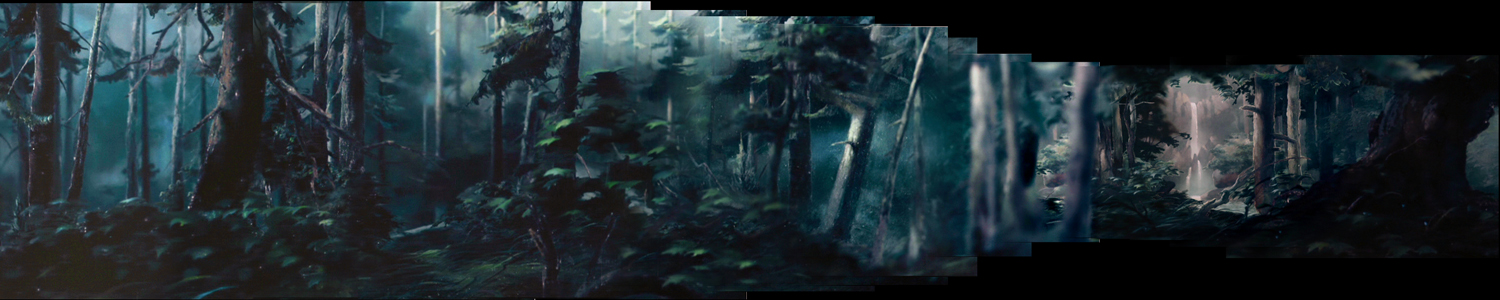
Colored in Photoshop, a first for me. ;)
MP3 Player
Thursday, March 1, 2012
Disneyear: Make Mine Music (1946)
Remember how I said in Fantasia that Walt wanted to make more Fantasia movies every year? Well you'll also remember that financially speaking, this was an ambitious idea at best. So that said, it seems a little ironic that Make Mine Music is pretty much the same movie as Fantasia? The difference being that this movie incorporates more popular music at the time with some classical music. If I'm right, some of these bits were leftovers from Fantasia. Is it as good? Let's find out.
Again, I'm looking at each segment of the film then reviewing the movie as a whole.
If you have an uncut copy of the movie, then the first segment of the film would be The Martins and the McCoys as sung by The Kingsman. The famous feud between the two hillbilly families ends when the last of each's kin fall in love. This is easily the funniest part of the movie, so this is a good start to the film. The reason why you don't see it in current copies is because of comic gun play. Kind of silly to me since Elmer Fudd is still out there blasting Daffy Duck's beak off...
The next segment is the Ken Darby Singers sing Blue Bayou. I've already talked about this segment in the blog, which you can view here. Kind of funny, I talked about this one right before I started the Year of Disney. Well, since most of my opinion of this is on that post, I'll skip this part.
Ok, moving on with Benny Goodman's All the Cats Join In. Wait, didn't I discuss this one too? Well, that was one of my first posts and my opinion's changed over time. While I still enjoy Goodman's music, this one feels like a mini time capsule for 1946. While it seems outdated in some parts, it still has charm.
What's next? Without You by Andy Russel. Like Fantasia's Toccata and Fugue in Fantasia, this one doesn't have much of a story, just some great imagery mixed with the music. It's done well and I love the atmosphere, but for some odd reason it doesn't strike a chord with me like Toccata and Fugue does.
Remember Casey at the Bat? Of course you do! If you don't, then you have no childhood. Just saying. Anywho, narrated by Jerry Colonna (who's going to be in another movie I'll review later this year) the great baseball player of 1902 plays for the win but his ego gets the best of him in the end. With great narration by Colonna, funny gags, well-timed, good animation on par with the great Goofy cartoons, this segment is one of my personal favorites. (I later found out that it's directed by Jack Kinney. No wonder I like it so much!)
The pace slows down a bit now with Two Silhouettes sung by Dinah Shore. Here, we see two dancers obviously rotoscoped to dance in front of animated backgrounds. Don't get me wrong, the choreography is great, but I think I respect it more than I enjoy it.
Up next is another leftover from Fantasia, Peter and the Wolf. Narrated by Sterling Holloway, the story is told in a slightly different manner than before, like the animals now have names, it takes place in the winter, and the duck comes out alive in the end. The music's still good, the animation is good, and I kind of enjoy Holloway's narration as usual. By the way, the Holloway counter is now up to four. There's also a little bit of Russian culture in the film. Even the language is shown from time to time. That's pretty cool. Despite the fact that there are superior adaptations out there, like Suzie Templeton's 2006 adaptation, I still regard this as another favorite segment of mine in the film.
Benny Goodman comes back in After You've Gone. It shows Benny's famed instrument of choice, a clarinet as well as a few others dancing in tune to the music. It's got great animation and music, but it's nothing special. I still enjoy it, though.
Johnny Fedora and Alice Blue Bonnet is a love story between two department store hats sung by the Andrews Sisters. We see poor Johnny get separated from his love, used by different people, and his endless quest to find Alice. In the end, they reunite as hats for horses and live happily together for the rest of their days. I think this is the cutest segment of the film. I like as much as I do another Disney short called Susie the Little Blue Coupe. Check it out. They're almost one in the same.
Disney saved the best for last in the bittersweet finale of The Whale Who Wanted to Sing at the Met. With an opera talent scout hears of a singing whale, he believes that the whale swallowed an opera singer. So he and a crew set out to "rescue" the singer. Turns out the whale, named Willy, really can sing. So he sets off to find the scout and perform for him with the hopes that he'll sing at the Met. This is easily the best segment in the whole movie. My favorite thing about it is that all of the singing voices in the cartoon are done by Nelson Eddy. All of them. That is epically amazing! I know not a lot of folks have seen this one, so I'll post only half of it and if you like it, you can keep watching it on Youtube. Without giving too much away, that sad face mask in the beginning sums up the ending.
And that's Make Mine Music. I found out a lot of folks bash it, but to be honest, I liked this film a lot. I think it's kind of underrated. While clearly not on par with Fantasia in that it's not quite as respectable as Fantasia, Make Mine Music still mostly entertaining. These segments later got cut into separate releases like Three Caballeros on the Disney Channel. The difference being that all of these shorts work well together and separate, unlike Caballeros, where it's fun at first but it wears off during the last third. My only qualm is that I didn't really enjoy two of the segments as much as I did the others. Oh well, that's me. I recommend checking this film out if you want to see all these shorts together and seeing them for yourself.
| Just saying... |
The next segment is the Ken Darby Singers sing Blue Bayou. I've already talked about this segment in the blog, which you can view here. Kind of funny, I talked about this one right before I started the Year of Disney. Well, since most of my opinion of this is on that post, I'll skip this part.
Ok, moving on with Benny Goodman's All the Cats Join In. Wait, didn't I discuss this one too? Well, that was one of my first posts and my opinion's changed over time. While I still enjoy Goodman's music, this one feels like a mini time capsule for 1946. While it seems outdated in some parts, it still has charm.
What's next? Without You by Andy Russel. Like Fantasia's Toccata and Fugue in Fantasia, this one doesn't have much of a story, just some great imagery mixed with the music. It's done well and I love the atmosphere, but for some odd reason it doesn't strike a chord with me like Toccata and Fugue does.
Remember Casey at the Bat? Of course you do! If you don't, then you have no childhood. Just saying. Anywho, narrated by Jerry Colonna (who's going to be in another movie I'll review later this year) the great baseball player of 1902 plays for the win but his ego gets the best of him in the end. With great narration by Colonna, funny gags, well-timed, good animation on par with the great Goofy cartoons, this segment is one of my personal favorites. (I later found out that it's directed by Jack Kinney. No wonder I like it so much!)
The pace slows down a bit now with Two Silhouettes sung by Dinah Shore. Here, we see two dancers obviously rotoscoped to dance in front of animated backgrounds. Don't get me wrong, the choreography is great, but I think I respect it more than I enjoy it.
Up next is another leftover from Fantasia, Peter and the Wolf. Narrated by Sterling Holloway, the story is told in a slightly different manner than before, like the animals now have names, it takes place in the winter, and the duck comes out alive in the end. The music's still good, the animation is good, and I kind of enjoy Holloway's narration as usual. By the way, the Holloway counter is now up to four. There's also a little bit of Russian culture in the film. Even the language is shown from time to time. That's pretty cool. Despite the fact that there are superior adaptations out there, like Suzie Templeton's 2006 adaptation, I still regard this as another favorite segment of mine in the film.
Johnny Fedora and Alice Blue Bonnet is a love story between two department store hats sung by the Andrews Sisters. We see poor Johnny get separated from his love, used by different people, and his endless quest to find Alice. In the end, they reunite as hats for horses and live happily together for the rest of their days. I think this is the cutest segment of the film. I like as much as I do another Disney short called Susie the Little Blue Coupe. Check it out. They're almost one in the same.
Disney saved the best for last in the bittersweet finale of The Whale Who Wanted to Sing at the Met. With an opera talent scout hears of a singing whale, he believes that the whale swallowed an opera singer. So he and a crew set out to "rescue" the singer. Turns out the whale, named Willy, really can sing. So he sets off to find the scout and perform for him with the hopes that he'll sing at the Met. This is easily the best segment in the whole movie. My favorite thing about it is that all of the singing voices in the cartoon are done by Nelson Eddy. All of them. That is epically amazing! I know not a lot of folks have seen this one, so I'll post only half of it and if you like it, you can keep watching it on Youtube. Without giving too much away, that sad face mask in the beginning sums up the ending.
And that's Make Mine Music. I found out a lot of folks bash it, but to be honest, I liked this film a lot. I think it's kind of underrated. While clearly not on par with Fantasia in that it's not quite as respectable as Fantasia, Make Mine Music still mostly entertaining. These segments later got cut into separate releases like Three Caballeros on the Disney Channel. The difference being that all of these shorts work well together and separate, unlike Caballeros, where it's fun at first but it wears off during the last third. My only qualm is that I didn't really enjoy two of the segments as much as I did the others. Oh well, that's me. I recommend checking this film out if you want to see all these shorts together and seeing them for yourself.
Friday, February 24, 2012
Disneyear: The Three Caballeros (1945)
Continuing the tradition of what Saludos Amigos did, Disney made a second film to show that the Good Neighbor Policy was still in effect. Thankfully, it looks like they realized the faults of Saludos and improved on it. There's more story, better entertainment, and really good live action/animation mixing in The Three Caballeros, making it not only more well-known to the public, but also regarded as a classic in some people's eyes. For Disney's first sequel, is it the best? Let's take a look.
The start of the movie shows Donald Duck getting three birthday gifts from fans and friends from South America. The first gift is a film reel and projector shows us different birds from South America, like parrots and the infamous Araquan bird. We also get two short stories. The first is about a penguin named Pablo who wants to leave Antarctica for warmer climates. The other is about a boy who finds a flying burro and enters him in a race. Both are really cute and more memorable than most of the shorts from the last movie (You know the one I mean!). Then Donald opens his present from Brazil and Jose Carioca returns to give Donald a tour of Bahia and slow the pace down for a bit. They dance for a bit with Aurora Miranda and then return to where we started. The third gift is from Mexico and we get introduced to a new character named Panchito Pistoles (rooster, Doug Walker! ROOSTER!). The three of them have fun, sing, dance some more, and then take a look at Mexico. Then the last third is Donald trying to score with the ladies (insert Beavis and Butt-head joke here.) Then they have more fun, fight a fake bull, and... that's where it ends.
Like I said earlier, this movie is better in that there's more passion thrown into it. The animation's a lot of fun, the stories are more memorable, the music's just as good and you still get some culture out of it. That's always good. In fact, this whole movie is like a party. But that's also what's wrong with it. Don't get me wrong, the first two thirds are fun, but after that, you kind of want to go and watch something else. After seeing people dance around for most of the flick, it gets boring fast. Also, that last third is such a mind-fuck! It's Donald trying to get a girl to make out with him mixed with some trippy imagery, which begs the question whatever happened to Daisy? There's also the fact that when they try to tell the stories, it's not that well stitched together. The movie jumps around from stories to fun to being educational to back to fun and it's kind of a messy presentation. In fact, the shorts are probably best on their own instead of all together, like they used to do on the Disney Channel.
So overall, this is a movie to watch on a rainy day. The storytelling is kind of jumbled and gets boring after the last third, but the animation, culture, music, and designs are the only consistent good things about it. Maybe if it had more focus, a lack of focus, or something consistent all the way, it'd be stronger. As is, it's okay. There's other Disney films out there that tell stories better and with better animation, so I'd recommend those. But if you're curious enough, The Three Caballeros has it's moments of greatness. Take it for what it's worth.
The start of the movie shows Donald Duck getting three birthday gifts from fans and friends from South America. The first gift is a film reel and projector shows us different birds from South America, like parrots and the infamous Araquan bird. We also get two short stories. The first is about a penguin named Pablo who wants to leave Antarctica for warmer climates. The other is about a boy who finds a flying burro and enters him in a race. Both are really cute and more memorable than most of the shorts from the last movie (You know the one I mean!). Then Donald opens his present from Brazil and Jose Carioca returns to give Donald a tour of Bahia and slow the pace down for a bit. They dance for a bit with Aurora Miranda and then return to where we started. The third gift is from Mexico and we get introduced to a new character named Panchito Pistoles (rooster, Doug Walker! ROOSTER!). The three of them have fun, sing, dance some more, and then take a look at Mexico. Then the last third is Donald trying to score with the ladies (insert Beavis and Butt-head joke here.) Then they have more fun, fight a fake bull, and... that's where it ends.
Like I said earlier, this movie is better in that there's more passion thrown into it. The animation's a lot of fun, the stories are more memorable, the music's just as good and you still get some culture out of it. That's always good. In fact, this whole movie is like a party. But that's also what's wrong with it. Don't get me wrong, the first two thirds are fun, but after that, you kind of want to go and watch something else. After seeing people dance around for most of the flick, it gets boring fast. Also, that last third is such a mind-fuck! It's Donald trying to get a girl to make out with him mixed with some trippy imagery, which begs the question whatever happened to Daisy? There's also the fact that when they try to tell the stories, it's not that well stitched together. The movie jumps around from stories to fun to being educational to back to fun and it's kind of a messy presentation. In fact, the shorts are probably best on their own instead of all together, like they used to do on the Disney Channel.
![]() |
| Still, the designs have moments of greatness |
That said, The Three Caballeros is still a decent movie to watch. The animation is really colorful and bouncy. The live action-mixing is done really well too and it's the first time that Disney did this since the Alice Comedies. My personal favorite scene is when Donald, Jose, and Panchito sing the title song. Really look at the pacing and timing of this scene! They move so fast that they practically leap off the screen! It's incredible!
Wednesday, February 22, 2012
Disneyear: Victory Through Air Power (1943)
I'll be honest here, I had a hard time trying to decide whether or not to review this film. Why? Well because as a Disney film, it gets little to no mention by a lot of the books I have since it's purely war propaganda. That may also explain why I had a bitch of a time trying to find this on DVD. But hell, it's here. I now have it. Let's review it.But first another history lesson: like how Saludos Amigos was developed, Walt Disney and his artists were asked by the government to do a film strictly for the U.S. Air Force based on Major Alexander de Seversky's well-known book. That or it got an actual theatrical release. I'm not sure which. A proud patriot, Walt agreed to do the film. The result is a film that's really unlike most of the films I'm reviewing this year. It's educational, like Saludos, but it's dead serious due to this film being for WWII pilots. Well, half of it anyway.
The best summary I can give is that the film starts appropriately with the history of the airplane. We see the Wright Brothers invent the first airplane with success. We also get a look at how the plane developed over the years and saw uses for mail, exploration, transportation and today's subject: war. About 25 minutes in, de Seversky himself appears and discusses the influence of air warfare in WWII and gives his ideas on how the war could be won by the Allies with strategic air bombing in Germany and Japan. That's pretty much it.
Well, this certainly is an unusual film for Disney. It's really like an audio/visual version of the book itself. For good reasons, it's really mature about it's subject matter and it's obvious that Disney and de Seversky knew what they were talking about. If you're a WWII enthusiast, you aren't going to be bored by this film. It's surprisingly engaging for something educational. It's kind of like a little time capsule from 1943. Sadly, that's also part of the movie's problem. It'll be hard for a modern audience to truly appreciate it.
I think one of the reasons this movie is forgotten is that this part of the movie is greatly concerned with what will be and what may be. Futurism is interesting to talk about when the futurist got things dead wrong, or only partially right. Since most of what de Seversky was discussing proved to be accurate, there isn’t much to mock. One might almost forget the context under which this was produced and see any inaccuracies as simple mistakes in research. The animation is also pretty limited here, despite how Walt felt about limited animation itself. In fact, it's also hard to recommend this to anyone other than the die-hard Disney fan or WWII enthusiast. If you can find it, I'd say check it out. I think you'll be pleased with the visuals and historical aspect of it.
The coolest part of the movie has to be the ending scene where an eagle representing America attacks Japan represented by an octopus. It's an intense scene but awesome too. From what I saw in an interview, Woolie Reitherman animated that scene. Judging from his interview, he really had a knack for suspense and drama
.
Saturday, February 11, 2012
Disneyear: Saludos Amigos (1942)
Like The Reluctant Dragon, Saludos Amigos was a Disney film that I never saw as a kid. Hell, I never heard of it before I started getting into animation! It's another obscure film that slipped under my radar. After watching it... well....there's a good reason why it's obscure. Not that it's god-awful (there's still some things that I like about it), it just could have been better. Much better.
Well, the best synopsis I can give is that the Disney artists take a plane over to South America for ideas for new films. They visit different parts of the land down below like Lake Titicaca, the pampas of Argentina, and Rio de Janero and show you the cartoon they came up with after each trip. That's. About. It.
So what are the cartoons? Like what I did with Fantasia, I'll analyze each little segment of the film.
Let's start with Lake Titicaca, where...
...How did they get here? Anywho, where Donald Duck visits the highest lake in the world and observes some aspects of the Andean culture. The trip ends quick when Donald and a llama get in trouble on a suspension bridge. Well, I think I analyzed it earlier in the blog and I think I praised it only for Milt Kahl's animation on the llama character. Looking at it again, the short is kind of boring. The llama scenes are actually the only entertaining part of the short. There's funnier Donald cartoons out there.
Then there's Pedro, the only short here with a coherent story. It's about a baby plane taking over his father's job of delivering the mail when he calls in sick. He succeeds and gains respect by braving the highest peak in the Andes mountains. It's a cute short, but it's the dullest short in the whole movie.
Next up is in the Argentine pampas, where we meet up with Goofy demonstrating the art of being a gaucho, or coyboy. Like a lot of the Goofy cartoons of the 40's and 50's, it has some great slapstick comedy and is easily the funniest short in the movie. But again, there are better Goofy cartoons to watch.
Last, but definitely not least is Aquarela do Brasil, or Watercolors of Brazil. We see an artist paint Brazil to the tune of Brazil, my all-time favorite song. Donald later appears and meets a green parrot named José Carioca. He shows Donald around Rio de Janero and introduces him to samba music. This is probably the only short that I really enjoy. The whole scene with the paint creating the Brazilian world in perfect harmony to the song Brazil is just awesome to me. It's really showcasing some of the best of Disney's art. There's also some scenes where the artist paints some things but it turns into something else, which is again really cool. Like you think he's painting a tree, but it's really a bird. Maybe if the whole movie was like this, I'd enjoy it more.
To sum it up, Saludos Amigos, well, kind of dull. The animation is still good as usual, but it's their short cartoon animation. Don't get me wrong, I love the short animations, but after seeing Bambi before this, this film seems like a downgrade.But as far as the short animation goes, this is some of Disney's best, even if not even all of the film is animated. My biggest problem with it is the presentation. The narrator is really, really boring. I'm sure he's trying, but he just didn't help make it entertaining. On top of that, this feels like someone's vacation videos slapped together with the short cartoons the artists came up with. Does that really count as a movie? Maybe as a featurette, but not a whole movie. But's it's far from being awful. On the bright side, it is educational, as in you get a little culture out of it and they do show different languages, dances, songs, ect. That's pretty cool, I guess. The music is also fun to listen to.
But this isn't very groundbreaking as a film and comes off, to me at least, very mediocre compared to the other Disney films. If I could improve it, I would have the whole film presented like the last short, Aquarela do Brazil and have
José and Donald show the audience around not only Brazil, but also other parts of South America and maybe bump into some of the characters along the way. If you want to see Saludos Amigos just to see all the Disney movies, go check it out. Otherwise, just have it as a matinee for your kids on a Saturday afternoon or just skip it.
Monday, February 6, 2012
Disneyear: Bambi (1942)
.... dammit....
But is that all there is to remember about Bambi? The answer is obviously no. It's one of those films that you appreciate more as an adult than when you where a kid. Why don't we find out why?
One morning in the spring, a baby fawn is born. This gathers the attention of all the woodland critters (thank God not the South Park ones...) because this particular fawn happens to be the prince of the forest. Why? Because.... deer are graceful. Anyway, he is christened Bambi and learns much about the forest while gaining friends in a rabbit named Thumper and a skunk named Flower. All throughout the seasons, little Bambi learns all the skills he needs to live from his mother. Then winter comes and... you-know-what happens. His father is there to take Bambi under his wing (or foreleg) and returns to the forest as an adult in the spring, antlers and all. After reuniting with Thumper and Flower all grown up, they later get twitterpated and meet their future mates, including Bambi with a fawn he met only once as a fawn named Faline. After a fight with another stag, Bambi has won Faline over. All's well until the most sinister of creatures enters the wood and makes life hell for the animals... MAN!! After a really intense climax, we cut to next spring when the forest recovers after a forest fire caused by man. It seems the cycle has started over again as Bambi and his father look over the next generation of forest royalty.
Where do I begin? Well, to be honest, the artwork in this movie is fantastic. The backgrounds, I hear, were done entirely in watercolor, a Disney first. And it's pulled off very well. It's like watching Planet Earth, you really feel like you're out in nature. Everything about it seems real. Even the animals are animated very realistically with a touch of that Disney style of course. I think that the animators must have actually studied how these animals act because their effort really shows. Just look at these beautiful backgrounds for case and point.
Another great thing about it is the atmosphere. What I mean by that is that it's never really in the same tone. It mixes a lot of warm and cute scenes with ones more dark and forbearing. I know a lot of people give that famous scene a lot of attention, but there's other really intense scenes. I actually thought the end scene where Bambi fights off the dogs and escapes a forest fire where more intense and far more dramatic.
Thankfully, the movie seems to find a perfect balance of happy with the dramatic stuff. Like I said before, the simplified version of the story is really the life of this one deer. The narrative isn't very coherent and clear cut. But, that's life! It's not always coherent and clear, there's not always heroes and villains, or even resolve itself in a poetic fashion. Bambi seems to reflect that aspect so well. It also doesn't rely on cliches in other kids or even adult films and thank God, because this is really all we need.
Like I said, the movie has less emphasis on story and more on character, and while Bambi himself isn't the most interesting character, but he's not supposed to be. He's more like the every man, an observer of the world, a blank slate and his character is carved from experiences. Also, there's something about Bambi's father. Every time Bambi sees him, he's more scared than happy. Sort of an interesting form of dysfunctional family we have here. Then again, I know that does are the ones taking care of the fawns and not bucks, so I supposed it's more true to nature this way. Nothing wrong with that. Since Bambi's the main focus, the other characters don't really have a chance for development, but they're still cute and enjoyable. I find myself liking Flower and that old owl had a lot of funny moments.
Best scene: too many to choose. But if you want to go for something more lighthearted, I just love the scene where Bambi, Thumper, and Flower as adults try to take an oath to never fall in love, but nature strikes back. Their reactions when they do get twitterpated are hilarious.
Overall, this is easily one of Disney's finest movies. The artwork and atmosphere mixed with a compelling coming-to-age story are way to good to pass up. Yeah, it gets intense at some parts, but I handled it fine as a kid and I suppose your kids can use some tough material. It's funny how even though I own the movie, this is actually one of the Disney films I watched the least as a kid and even as an adult. It's kind of like Citizen Kane or the Stanley Kubrick library, I respect it more than I watch. And I think that theory holds true for a lot of folks. Just have a tissue-box ready for when it happens.
Thursday, February 2, 2012
Disneyear: Dumbo (1941)
Whenever I watch animated films, I can't always expect something with the majesty of Snow White or Fantasia. Sometimes, just having a lot of charm is enough to make me like them. Dumbo is one of those movies.
One night, storks are delivering babies to circus animals in modern-day Florida (which begs the question: if storks deliver the babies, then what makes the babies?) One of the late deliveries of the circus is a baby elephant with unusually large ears. The other elephants make fun of him to the point where they ostracize him for his large ears, but his mother is there to give him love and care. One day, momma Jumbo tries to protect little Dumbo from jeering bastard-kids but gets caged and chained later because the people though she was attacking the kids out of nowhere. The only person there for him is a little mouse with a ringmaster clothes, a New-Yorkese accent, and a heart of gold. He tries to help Dumbo become accepted but as a result from one disastrous mistake on an act, Dumbo gets demoted to a clown. After a visit with his mother, Dumbo and the mouse get drunk (the mouse was trying to cure Dumbo's hiccups with what he thought was water) and wind up in a tree the next morning. The mouse tries to figure out how the hell the both of them wound up in a tree and come to the conclusion that Dumbo flew up the tree. With the help of some crows, Dumbo learns to fly and becomes a big hit in the circus. They even free momma Jumbo in the end! Yay!
That's the story. How does it fare?
Like I said earlier, Dumbo is a very charming film. It's not as artistically groundbreaking as Snow White or Fantasia, I don't think it was ever supposed to be. It just sets it's own rules and boundaries and performs well under them. As Doug Walker put it, the story is your typical outcast-with-what-appears-to-be-a-handicap-but-in-the-end-works-in-his-favor-and-becomes-accepted-by-society story, like Rudolph the Red Nosed Reindeer. The characters were a lot of fun and I enjoyed them for the most part. My personal favorite? Dumbo. It's rare for me to say I liked a main character in a Disney flick since I adore side characters mostly, but I just can't help but love the little guy. Even as a kid, I remember loving Dumbo to the point where I wanted him as a pet. What can I say, I love elephants. They're my favorite animals. Most of all, I find it fascinating that the Disney animators gave Dumbo a strong personality and not even give him a line to say.
![]() |
| How could you not love him? :3 |
Speaking of characters, I'm sure a lot of you are curious to know how I feel about the crows seeing how they've caused some controversy over the years. Yeah, it's true that they speak slang and have mostly black actors portraying them (the leader is played by Cliff Edwards, who did the voice of Jiminy Cricket), but Disney never pulled them off like Sunflower in Fantasia or Song of the South. Well, truth be told, I really like these guys too. They're cool, they're classy, they have style, they become one of the few friends of our main hero and even help him fly. They're f-n awesome! But hey, there may be something I'm missing here, feel free to give a shout on that.
The best scene? With out thinking twice, the pink elephants sequence. Yeah, it's pointless and it traumatized a lot of my friends, but it's awesome!
Overall, I really have a soft spot for this movie. It's simple and really enjoyable with some good animation, even if it feels like I'm watching a short cartoon. But hey, I still love it. And apparently, so do a lot of folks. After doing some research, I found out that this movie actually cost a third of what it cost to make Snow White. It wound being such a big critical and financial success that it made over $1 million back. It's a little film that really helped Disney in the long run because had the movie failed, the studio would have likely closed down. I'm grateful for that, so that's another reason why I always find myself putting Dumbo in my top 10 Disney films.
One more thing: here's an ode to all the moms out there. Love you, Mom and thanks for everything.
Friday, January 27, 2012
Disneyear: The Reluctant Dragon (1941)
Before this point in the Year of Disney, we've witnessed some of the greatest animated films the studio will ever produce. Ever wonder how they made those films? This movie (or documentary?) is your answer. Let's take a look.
Our film begins at the home of comedian Robert Benchley. His demanding wife claims she has an idea for a new Disney cartoon based on Kenneth Grahame's (author of Wind in the Willows) story, The Reluctant Dragon and demands that her very reluctant husband go to Disney himself and pitch the idea. He goes there and actually gets more than he bargained for with an entire tour of the studio. Benchley gets to see every single process that goes through an animated film, from concept art to camera work, concept art, storyboards, sound effects, voice overs, how to impersonate Donald Duck, and more. He has a good time getting to know some of the artists until he meets uncle Walt himself and shows Benchley his latest short film. In some kind of a cruel twist, it's The Reluctant Dragon. After that, Benchley nags at him about getting there earlier to pitch her idea, he gets back at his wife by throwing a small tantrum a la Donald.
Until I started looking at animation, this was one of the few Disney films that actually stayed under my radar. I mean, I've seem the titular short before, but never in it's source material. I will admit that after seeing it for the first time, I actually kind of enjoyed it. Like I said, you get a glimpse at how Disney made these cartoons before today's methods and even (what was then) a sneak-peek of some of the films I'm going to review next, Dumbo and Bambi. Benchley himself is entertaining and it is nice that you get to know the people that work on these films. More than what I can say for Saludos Amigos. The film also starts in black and white but ends in color. Sounds weird, but I think it's supposed to show how camera technology has changed, which is nice. You also get to see some short cartoons in between. The only thing I think I didn't care for was that officer that gives him the tour and Benchley's wife. They came off as kind of annoying to me.
The cartoons themselves are nice.I liked the Baby Weems story (done entirely by storyboards, but they were in that department so it makes sense.) and the Goofy cartoon, How to Ride a Horse, is hilarious. The title cartoon was only ok, I thought. The animation and colors are nice and it does actually get a laugh out of me, (especially the dragon and Sir Giles' "fight"). Trust me, I didn't expect the dragon to sound like he does. Hell, I saw the picture of him before and though the was a girl! Didn't see that coming, but he does get a laugh out of me by just how... well, femmy he was. It makes up the final 20 minutes of the film which kind of fits into Mr. Benchley ironic situation. It's funny and entertaining, but not Disney's best short.
So that's The Reluctant Dragon. If you're interested in the process of traditional animation or if you just want to see some entertaining cartoons, I'd say give this movie a shot.
Here's some poetry from our dragon.
Wednesday, January 25, 2012
Disneyear: Fantasia (1940)
For a while now, the Disney movies had simple, yet coherent stories to them. So for their third feature, Fantasia, it seems odd that they did the total opposite of that. It's not one story, but seven pieced together with classical music. The result is a film that's more than just a movie. It's a powerhouse of art and sets new standards for not just animated films, but music videos too. It's really the first Disney film mainly for adults, but there are things that kids can enjoy about it. It's not just my favorite Disney film, it's one of my favorite films of all time. Like I said before, it's not just one story, but a bunch of them with no dialogue except from our host, Deems Taylor and a scene with Mickey Mouse and our conductor, Leopold Stokowski. So because of that, I'm going to analyze each segment and then review it as a whole in the end. I'll do the same for other films like this, fyi. So, let's get started!
We get our introduction from Deems Taylor about how the film is going to be. He states that there are three kinds of music: First, there's the kind that tells a definite story. Then there's the kind that while it has no specific plot, it does paint a series of more or less definite pictures. And then there's a third kind, music that exists simply for its own sake. The first piece is music of the third kind, Johann Sebastian Bach's Toccata and Fugue in D Minor. What we see are a bunch of abstract images. It may seem pointless, but if you listen to it again and close your eyes, these images may be the first to jump in your mind. It's a very interesting and bold way to start your movie and easy one of the best scenes in the film.
The second is Pyotr Tchaikovsky's The Nutcracker Suite. This scene has a lot of nature themes in it, the biggest idea being that fairies control morning dew and even help with the changing of seasons. As the music goes on, we're also introduced to Chinese mushrooms, dancing flowers and goldfish, and end with summer turning into autumn and winter. It's another scene with powerful imagery. Sometimes, just the falling of leaves has a bigger impact than the internal struggles of a character. It's amazing how these artists can read nature as if it's poetry or ballet. It's a great part and one I always enjoy seeing.
Next is the most famous scene: Mickey Mouse starring in Paul Dukas' The Sorcerer's Apprentice, and the first clear-cut story in the film. We see Mickey learning under a sorcerer named Yen Sid (see if you catch that reference!) as well as doing a few chores for him. One day, the master leaves his hat, leaving our mouse to make some mischief by turning a broom alive to do the work for him. Only problem is the broom doesn't stop. So, thinking fast, Mickey chops it up with an ax only to have it multiply. They flood the place until Yen Sid comes back and fixes everything. Obviously, this is the most kid-geared section of the music, but I'd be lying if I said it wasn't entertaining. Fun fact: this short is actually how the film came about. It was originally supposed to be just this one, but Disney must have liked the idea and wanted to try it out some more music and stories. The love really shows here and in the other segments.
Now we have Igor Stravinsky's The Rite of Spring. Originally a series of tribal dances, the Disney artists had recreated Stravinsky's original idea for the piece: the evolution of life (at least up until the dinosaurs to avoid problems with religious folks.) This is probably my second favorite segment in the movie. There's a lot of drama and more serene moments in here, but that's life itself. Emotionally, I'm never sure how to feel when watching this. The dinosaurs are there, then they're gone. That's it. There's no good vs. evil, there's no heroes or villains. It's animals living their lives. And I always find stuff like that fascinating.
After that, we take a break and see the orchestra take a jazz break and watch a segment with an animated soundtrack. It's a nice break and this segment does get a chuckle out of me. On top of that, the animation on the soundtrack, like the rest of the film, is beautiful. So, I'd say don't skip it.
We come back to see an interesting interpretation on Ludwig van Beethoven's Pastoral Symphony (#6). Instead of the German countryside, like how Beethoven originally envisioned, we see a delicately colorful meadow inhabited by creatures and Gods of Greek mythology, like unicorns, satyrs, pegasus families, centaurs in love, a party hosted by Bacchus and his unicorn donkey (something I'd actually like to attend. He seems like a cool guy.), Zeus breaking up the party, and everyone settling down as the days end. It's pretty colorful and I have to admit, I do enjoy this segment too. It's at least in a lighter mood after the last, really heavy segment. I should also bring up the fact that this is usually censored in almost all prints available. Disney later edited out a black centaur character named Sunflower that acted as an assistant to all the other lady centaurs. I have seen a version with this character in it from YouTube (I guess someone had the original reel) and can tell you that while it's not the most racist thing I've ever seen (It's actually hard to tell with Disney...), Disney should at least have this open for people to make fair judgments for themselves. Another thing, they kept two zebra-centaurs in the film, so why edit Sunflower out if you're going to leave those two in? Besides, the efforts to edit her out are really obvious and a little distracting.
Ok, now we have Amilcare Ponchielli's Dance of the Hours as performed by hippos, ostriches, crocodiles, and elephants. Different parts of the ballet represent different parts of the day both visually and audibly. Out of all the segments in the film, this one is probably the funniest. There's some good, silly, physical humor in it while keeping a sense of dignity like the rest of the film. The choreography of the dancing is good, too.
At last, we come to the finale of Fantasia. Combining Modest Mussorgsky's Night on Bald Mountain with Franz Peter Schubert's Ave Maria sounds like an odd way to end your movie, but they contradict each other so perfectly that it's downright beautiful. It combines all the darkest and most evil things on earth (including a kick-arse devil animated by Bill Tytla) with all the goodness in the world prevailing over it. This has to be, emotionally speaking, the most powerful scene not just in the movie, but out of everything Disney has done that I'm reviewing this year. I swear, that choir brings a tear to my eye every time...
So that's the film in a nutshell. It's a very powerful tour de force not just in film, but the art of animation itself. Remember what I said about Snow White and Pinocchio working due to emotional simplicity? You could argue that this is the film that perfects that concept. I also enjoy the fact that it's not about story, but moments. Some are easy to emotionally identify with, others not so much. There's also the fact that the Disney artists are able to suck you into a film so simple and yet so awe-inspiring. It's like going to an art museum if the exhibits were alive and moving in front of you. It's Disney's magnum opus. So, to me at least, this movie ages like fine wine and is easily Disney's masterpiece.
If I could find one fault in the movie though, it's that it may be an acquired taste to some. After all, not everybody was brought up on classical music like I was. I still remember my first classical CD: David Bowie narrating Peter and the Wolf performed by Eugene Ormandy and the Philadelphia Orchestra. So, maybe this is why only a handful of people I know love this movie like I do. Who knows? Maybe if some folks watch it again, they'll at least appreciate the animation and it's sophistication. After all, everyone's entitled to their opinions and I still hold mine.
Fun fact here: Walt originally wanted this to be a part of a continuing series of films. Unfortunately, this film didn't make the money it needed back when it was first released (even though it was the 2nd or 3rd highest grossing film that year), making another was financially ridiculous. One was made almost 60 years later, but I'll get to that one when it comes around.
How about some clips? Here's The Nutcracker Suite and Night on Bald Mountain/Ave Maria with some scenes of Sunflower that I mentioned.
Wednesday, January 18, 2012
Disneyear: Pinocchio (1940)
The story goes that one night a long time ago, a puppet maker in a village (I'm guessing in Italy) makes what he considers his best work yet: a little boy marionette he names "you-should-know-this-by-now". He makes a wish to a wishing star and wants nothing more than his puppet to be a real boy. Then suddenly, a Blue Fairy comes by and grants Gepetto his wish and appoints a little cricket named Jiminy Cricket to be the boy's conscience. The fairy also mentions that if Pinocchio learns right from wrong, he'll be a real boy. Together, the two overcome some obstacles so that Pinocchio can get his wish to be a real boy. After an exciting climax escaping a ferocious sperm whale, he sacrifices his own life to save his father. Seeing this, the Blue Fairy gives him life again, Jiminy receives an official conscience badge and they all lived happily ever after.
First off, I should point out that the animation in this film is simply beautiful. Some of Disney's best even. Right down from the first ten minutes, you get some really gorgeous imagery. Take a gander.
As weird as this premise sounds, the artists create this world for the movie where it doesn't have to make sense. I especially love it when Honest John (a fox) and his pal Gideon (a cat) are just walking down the street like normal people and are shocked to see a marionette skipping past them on his way to school. It's pretty damn hilarious when you think about it. There are more weird images than this in the film, like the nose growing when Pinocchio tells a lie or turning into a donkey when he's bad. But at least it has a purpose: it's there to teach lessons. And with visuals like that, they sort of stick to you like a burr to your sock.
![]() |
| Remember kids: lies grow until is as plain as the nose on your face! |
Like Snow White, emotional simplicity is what makes this film endearing. The difference being that in Snow White, where if you have a dark/sad moment, things turned out alright in the end. Here, it's not always like that. The bad guys were never defeated, they're still out there doing what they do, like the coachman (who I consider the most underrated Disney villian). He kidnapped boys and turned them into donkeys where they got sold to miners. He also keeps the ones who can still talk and God knows what he's gonna do to them. And, you know what? HE'S STILL OUT THERE KIDNAPPING MORE KIDS!
![]() |
| Oh, and this isn't the creepiest face ever! |
![]() |
| It's okay. Sing your heart out, Jiminy. |
Feel brave enough? Here's the creepiest scene in the whole film... Enjoy!
Hope this makes you feel better: the most beautiful scene.
Subscribe to:
Posts (Atom)